
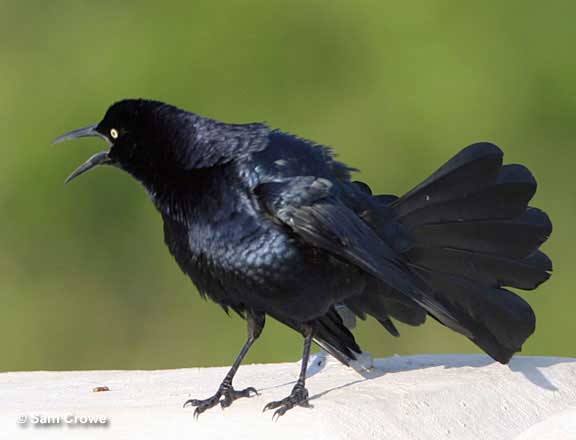

Have you seen or heard about the Great-tailed Grackle? These birds are well-known because they love hanging out in the suburbs, parks, cemeteries, and parking lots. They’ll even visit backyard bird feeders.
Great-tailed Grackles flock together, both males and females, and gather in “roost trees.” These “roost trees” can contain thousands of Great-tailed Grackles. In fact, Texas’s Rio Grande Valley has seen its sugarcane fields hold up to half a million of these birds!
Great-tailed Grackles are common in the southwestern and central United States. They can be seen year-round in southwestern states like Texas, New Mexico, Arizona, Mexico, and Central America.
Identification
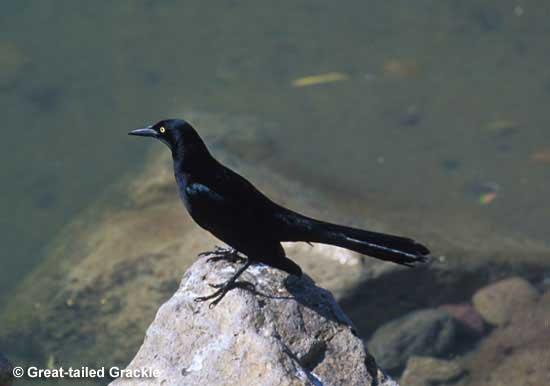
Male Great-tailed Grackles are slender blackbirds. They have long legs, flat heads, and straight, stout bills. The stand-out feature of these birds is their tails. The tail is tapered and is almost as long as its body. It folds into a distinctive V-shape. Males are iridescent black, have black legs and bills, and have striking yellow eyes.
Like males, female Great-tailed Grackles have long legs, flat heads, and straight, stout bills. However, that’s where their similarities end. They’re half the size of male Great-tailed Grackles and have slender, long tails.
Females are dark brown on top and paler brown below. They have a brownish-yellow throat and stripe above the eye and light yellow eyes. Juveniles have the same dark brown plumage females have, but they have dark eyes and streaked underparts.
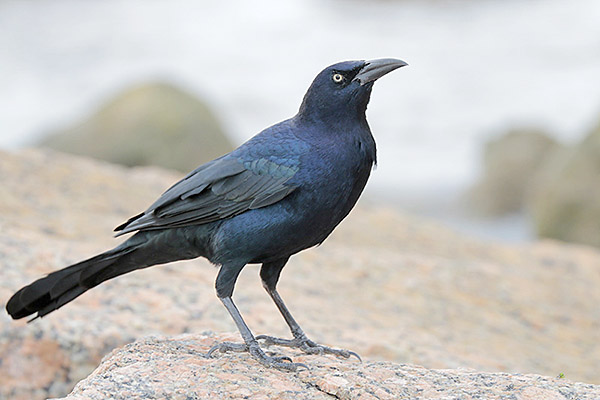
Photograph © Greg Lavaty.
Food
Great-tailed Grackles are omnivores; their diet varies greatly. However, Great-tailed Grackles can often be seen eating plant materials. Some plant materials they consume are grains like sorghum, oats, corn, and fruits.
Later in the year, like in the summer and fall, animals make up most of their diet. In fact, females eat up to 80% animal matter. Some animals they’ll consume are beetles, grasshoppers, bees, spiders, wasps, worms, snails, moths, and slugs.
Great-tailed Grackles have also been known to feed on frogs, tadpoles, lizards, fish, snakes, and small mammals like shrews and mice. Sometimes these birds will even eat eggs and nestlings from other birds.
Nesting and Eggs
Female Great-tailed Grackles are the ones to choose the nesting site and construct the nest. They’ll pick a place in a shrub or tree that’s as high as possible. To put that in perspective, nests can be 60 feet off the ground.
Foraging and water areas will be nearby, and several twigs are usually in an upright position for anchoring. When there aren’t any acceptable trees, female Great-tailed Grackles will choose to put their nests in marsh vegetation like rushes and cattails or on human-made structures.
Females have been known to abandon their current nesting site in favor of another.
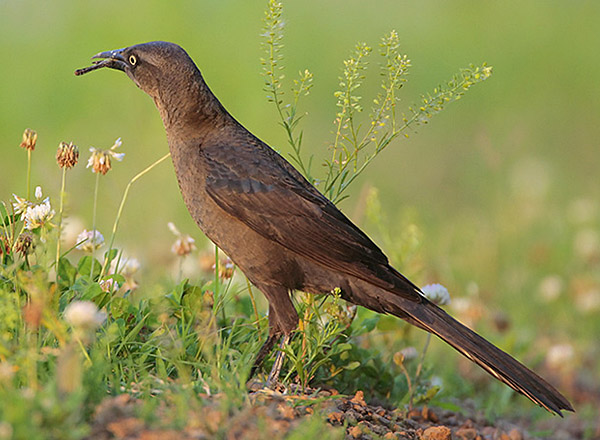
Female Great-tailed Grackle – Photograph © Greg Lavaty.
When building a nest, female Great-tailed Grackles will intertwine bark strips, grasses, rushes, weeds, and other plants into the nest. These are also used to anchor the rim of the nest to small branches and upright twigs. Weaving material can also include ribbons, plastic bags, flagging tape, string, and feathers.
The nest cup will be lined with cow dung or mud, and a soft inner layer of fine grasses will be added after. Total nest completion can take 5 to 17 days. Males sometimes guard the site while it’s being built so other females can’t steal nesting material.
The completed nest is 7.5 inches wide and has a depth of 4 to 13 inches. The inner cup will measure 4 inches wide and have a depth of 2 to 4 inches.
- Clutch size can range from 1 to 5 eggs.
- Egg length can be anywhere from 1.1 to 1.5 inches (2.7 to 3.7 centimeters).
- Egg width can be anywhere from 0.8 to 0.9 inches (2.1 to 2.4 centimeters).
- Eggs are usually a pale bluish-gray or bright blue. In addition, they’ll have splotches of either black or dark brown.
Current Situation
Great-tailed Grackles have followed where people go for quite some time. Even today, they are often seen in urban and agricultural settings.
They love open foraging areas near a water source with trees or hedgerows. In rural areas, this grackle species can be seen foraging for seeds in newly planted fields, farmyards, and feedlots. They also like to follow tractors to feed on worms that get dug up and flying insects.
In town, Great-tailed Grackles can be seen foraging in neighborhood lawns, at dumps, and in parks. You’re unlikely to see them in places that lack water, like prairie habitats, deserts, and dense forests.
Great-tailed Grackle populations were stable and slightly increasing in their range between 1966 and 2019. It’s estimated that the global population is 30 million.
According to the IUCN Red List, these birds are a species of low-concern species. In the western portion of the United States, the Great-tailed Grackles range has expanded more than any other bird.
However, to many people, these birds are considered pests because they eat sorghum sprouts and young corn plants. They’ll also feed on citrus fruits in groves and raid White-winged Dove nests. Citrus and grain growers will haze, shoot, or use chemical repellents to deter the birds.
Facts
- In the early 20th century, the northern edge of the Great-tailed Grackle’s range hardly reached south Texas. But, since the late 20th century, they’ve followed the spread of urban development and irrigated agriculture into the West and the Great Plains. This made them become one of North America’s fastest-expanding species of bird.
- The spiritual meaning of grackles is to be yourself and not bring yourself down by trying to please other people. Seeing a Great-tailed Grackle may mean that you’ve been thinking of doing something that goes against your beliefs for acceptance. The Great-tailed Grackle appeared to remind you not to compromise. Listen to your intuition, and you’ll find yourself making the right choices.
- Female Great-tailed Grackle nestlings are more likely to survive than their male siblings because they’re smaller and require less food to survive. Additionally, adult female grackles may outlive adult males. As a result, this species has a “sex-biased” population; there are more females than males.
- More often than not, you’ll see Great-tailed Grackles feeding on land. However, they have been seen wading in the water to catch fish or frogs.
- The Boat-tailed and Great-tailed Grackles were once considered to be the same species. Now, we can see that they’re closely related but are different species of grackle.
Similar Species
The Great-tailed Grackle has features that are similar to other bird species. Here are some similar species:
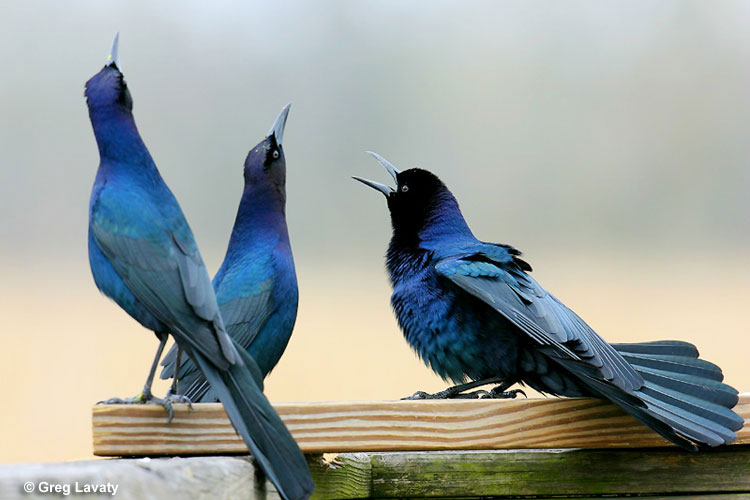
Boat-tailed Grackles
Boat-tailed Grackle – The Boat-tailed Grackle overlaps when it comes to their range with the Great-tailed Grackle.
Great-tailed Grackles have yellow eyes, while Boat-tailed Grackles have dark eyes.
Female Boat-tailed Grackles also tend to have a darker brown color below.
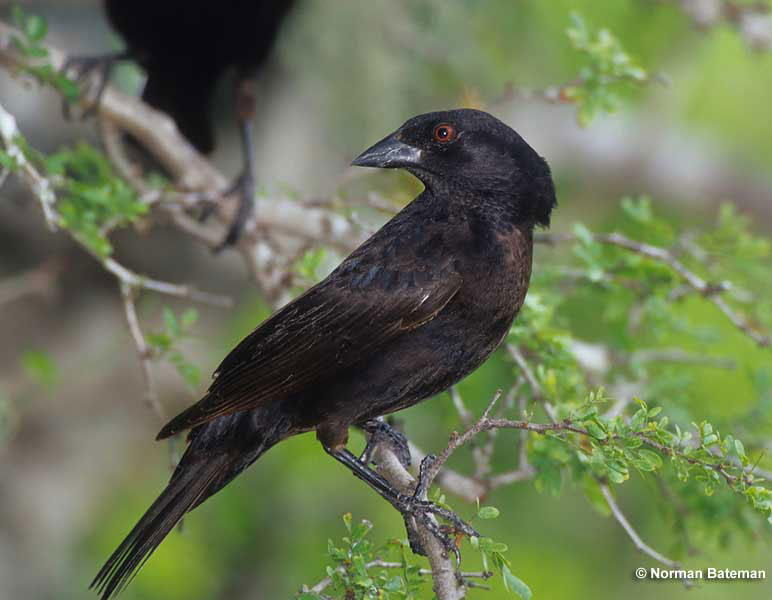
Bronzed Cowbird
Bronzed Cowbird – Bronzed Cowbirds have shorter tails and are smaller than Great-tailed Grackles.
Great-Tailed Grackle has a wider range in Central and North America.
Bronzed Cowbirds can only be spotted in Central America and some areas in the United States.
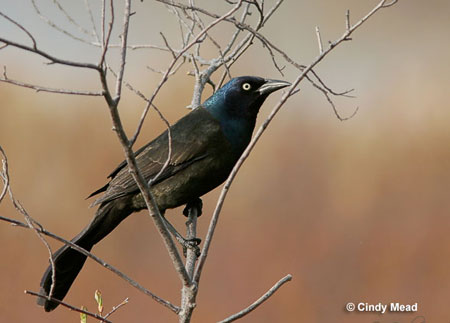
common grackle
Common Grackle – Common Grackles have flatter, shorter tails and are quite a bit smaller than Great-tailed Grackles.
These grackles tend to live in the eastern parts of the United States, while Great Tailed Grackles tend to prefer the western side.
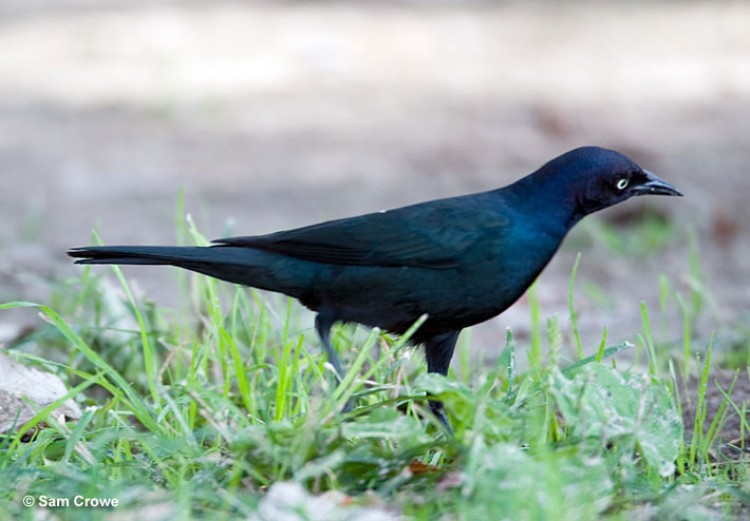
Photograph © Greg Lavaty.
Brewer’s Blackbird – Althoughthey look similar, Brewer’s Blackbirds have shorter bills and tails.
They’re also smaller in size in comparison to Great-tailed Grackles.
Brewer’s Blackbirds are widespread over most of North America and tend to prefer open grounds and populated areas.
Great-tailed Grackles tend to prefer wilder areas.
FAQ
Are Great-Tailed Grackles rare?
No, Great-tailed Grackles are not rare. These birds love to hang out in the suburbs, parks, cemeteries, and parking lots, making them extremely easy to see. They’ll even visit backyard bird feeders. Great-tailed Grackles are common in the southwestern and central United States. They can be seen year-round in southwestern states like Texas, New Mexico, Arizona, Mexico, and Central America.
Are Great-Tailed Grackles related to crows?
No, Great-tailed Grackles are not related to crows. Grackles are a part of the Icteridae family, also known as the blackbird family. The family includes birds like cowbirds and orioles. Crows are a part of the corvid family; this family includes magpies and jays.
Do Great-Tailed Grackles eat other birds?
Great-tailed Grackles don’t eat other birds but sometimes eat eggs and nestlings from other birds.
Are grackles aggressive?
Grackles are aggressive toward other birds and can even be aggressive toward humans. These birds are very noisy and have been known to swoop down and attack people walking or biking if their nest is nearby.