
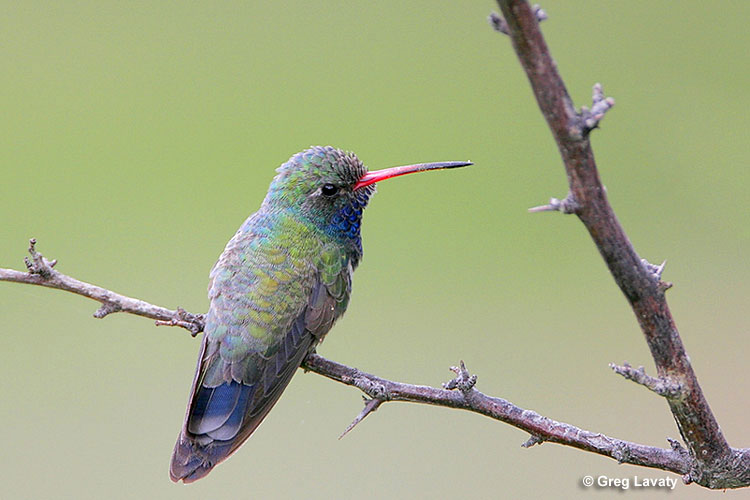

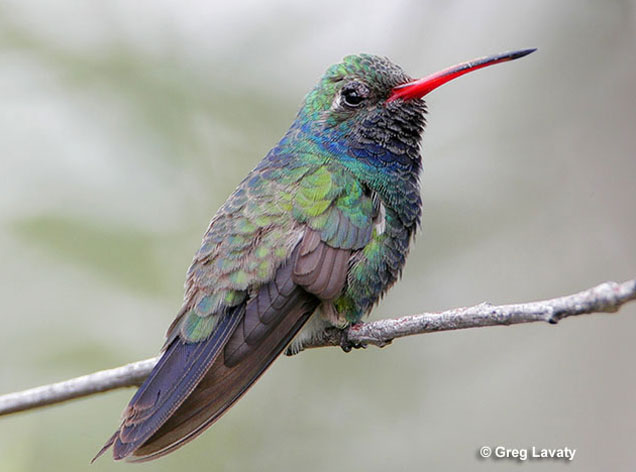
Broad-billed Hummingbirds (Cynanthus latirostris) are small, very vibrant birds native to Mexico that happen to breed in a small area of the southwestern United States. They are recognized for their relatively broad and reddish bill.
They are not that common in North America, so if you think you’ve seen one, take a closer look and see if it matches the description.
Identification
Broad-billed Hummingbirds are small and slender, measuring around 3.1-3.9 inches long with a wingspan of 5.1 inches. Their most distinctive feature is their broad and straight bill, which is relatively longer and wider compared to other hummingbirds. It is also red with a dark tip, rather than just black.
Male
Male Broad-billed Hummingbirds have stunning and vibrant plumage. Their bodies are iridescent dark green, they have blackish wings, very dark blue tails with rounded corners and a notched center, and white undertail coverts. The throat, or gorget, is a particularly striking feature, often displaying shades of iridescent violet, blue, or turquoise. Males are slightly larger than females and have a brighter red bill.
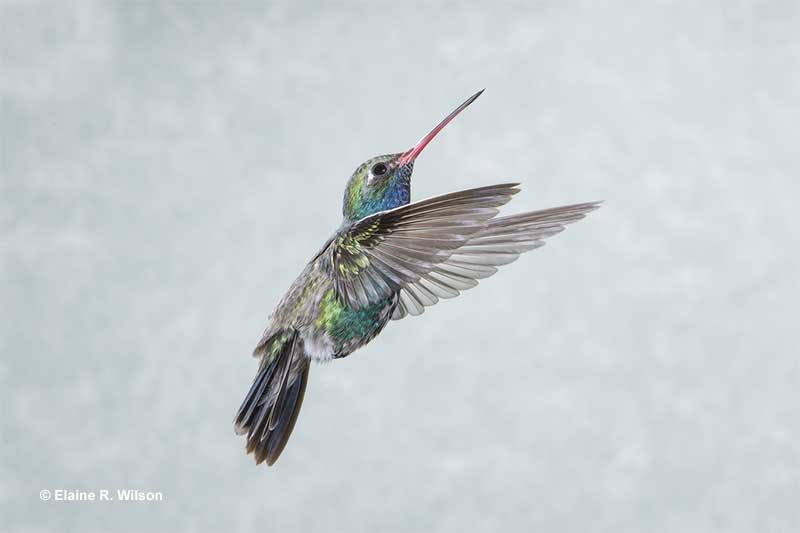
Immature males resemble females. They have greenish uppersides, grayish undersides, and a white line above the eyes. As they get older, patches of iridescent green or blue feathers start to appear on their underside as well.
Female
Female Broad-billed Hummingbirds are noticeably less colorful than males. Their upperparts are green with golden iridescence, and their underside, including their throat, is gray. They have dark tails with a notched center, squared corners, and white tips. The red of their bill isn’t as bright as in males.
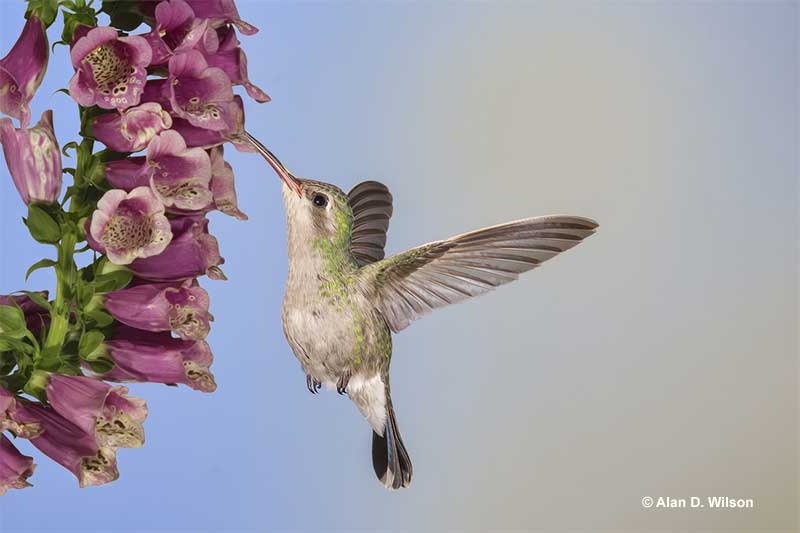
Juvenile Broad-billed Hummingbirds resemble females. You can tell whether the juvenile is a male or a female thanks to their tail. Females have white-tipped tails, whereas males do not.
Vocalizations
While their vocal repertoire is not as extensive or complex as some bird species, they do produce distinct noises. Broad-billed Hummingbirds emit sharp and rapid chirping or chipping that sounds like chi-dit. These chirps and chips are commonly used during interactions with other hummingbirds, especially in territorial disputes or courtship displays.
In addition to their vocalizations, Broad-billed Hummingbirds may produce buzzing sounds with their wings during flight, which is a characteristic feature of hummingbirds in general. During courtship dives, males also call with a whining zing.
Food
The diet of Broad-billed Hummingbirds primarily consists of nectar from flowers, especially red flowers, but the specifics vary seasonally.
Some overall most commonly visited flower species include ocotillo, honeysuckles, bird-of-paradise, mescal agave, fireweed, desert willow, scarlet bugler, superb penstemon, milkweeds, morning glory, and paintbrushes.
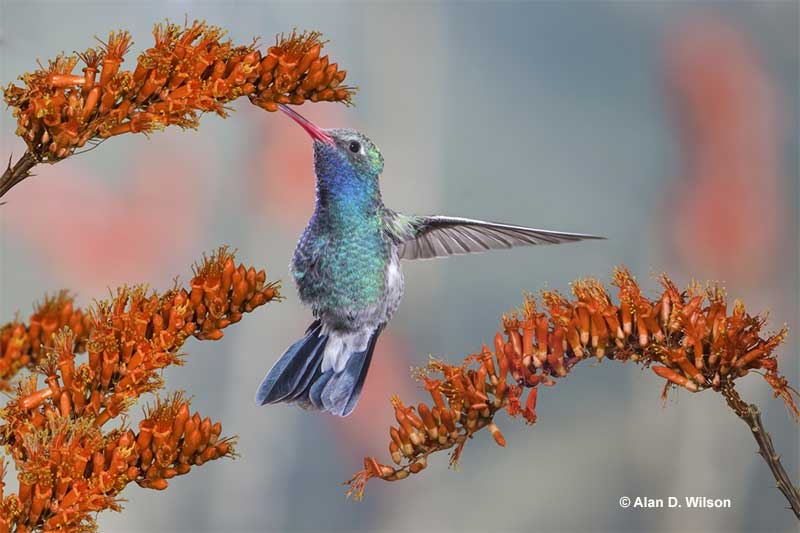
In spring, they prefer to gather nectar from Mohave beardtongues, while in the summer, they go for agaves. They prefer to feed in the morning or late afternoon since flowers have the most nectar then.
In addition to nectar, Broad-billed Hummingbirds incorporate insects and spiders into their diet. They are skilled at catching small flying insects, such as gnats, mosquitoes, and fruit flies by snatching them mid-air or gleaning them from foliage. This is especially important during the breeding season.
Nesting and Eggs
Like other hummingbirds, Broad-billed Hummingbirds are not monogamous. Males mate with many females and then leave the female to nest and care for the young on her own. Courtship includes males calling from perches and then putting on a flight display when a female appears. Males fly from side to side, sometimes up and down, calling and chasing the female.
After that, the females go on to build a nest. Broad-billed Hummingbirds nest on horizontal drooping branches or in the forks of low deciduous trees or shrubs 3-9 feet off the ground.
The cup is woven of fine grasses, bark strips, leaves, and spider silk, measuring around 1 inch tall. They line it with plants down and sometimes use leaves or bits of bark to camouflage the outside of the nest.
Females generally attempt to have 2 broods in a year with 2-3, most commonly two tiny white eggs in a clutch. Broad-billed Hummingbird eggs measure just 0.5 inches long and 0.3 inches wide.
Incubation takes around 14-23 days, after which the female broods and feeds the young. The latter is done by her sticking her bill into her younglings’ mouths and regurgitating a mix of tiny insects and nectar. It is unknown how long it takes the young to gain independence.
Current Situation
Broad-billed Hummingbirds range throughout most of Mexico with resident populations focusing around northwestern Mexico. Their breeding range extends north into southeast Arizona, southwest New Mexico, and rarely into southwest Texas.
During the breeding season, Broad-billed Hummingbirds reside in semi-open habitats like streambeds, foothill oak woodlands, and canyons at around 3,000-5,000 feet.
In the U.S., they may go as high as 9,800 feet to forage. In winter, they inhabit a wider range of areas, such as lowland thorn forests and wet tropical deciduous forests.
Broad-billed Hummingbirds are listed as of least concern on the IUCN Red List. Although the exact number of their population is unknown, then it appears to be stable. In the 19th century, hundreds of thousands of hummingbirds were killed for their beautiful iridescent plumage, but it seems that this species has recovered.
Facts
- Broad-billed Hummingbirds are known for attacking diurnal owls, diving at them, and calling. Other birds often join in in an attempt to chase the predator away. It is theorized that it’s done to alert other birds of its presence, drive the predator away, and/or help the young understand what a predator looks like.
- The oldest Broad-billed Hummingbird on record was 9 years and 1 month old.
- Female Broad-billed Hummingbirds flap their wings to mold the nest to their body. In addition to that, the nest expands as the clutch grows, thanks to the spider silk woven into it.
Similar Species
This is a more unique-looking hummingbird, so there are less similar species. The species that do look similar, such as the White-eared Hummingbird and the Blue-throated Mountain-gem, however, have some characteristics that easily separate the two. Let’s take a closer look.
White-eared Hummingbird
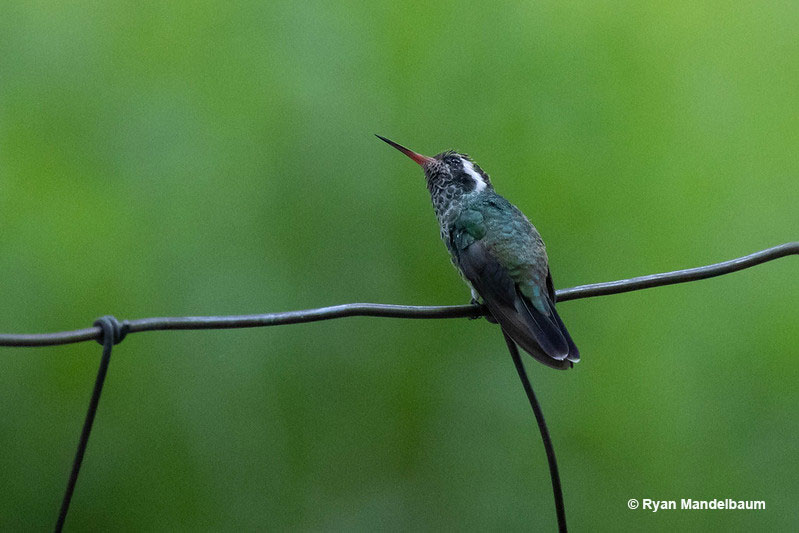
White-eared Hummingbirds are common in Mexico but uncommon visitors to the southwestern United States. Males have a dark iridescent green plumage with a coppery sheen, a dark iridescent purple forehead, bluish throats, and a reddish bill with a dark tip. Females resemble males but are duller overall, have a brownish crown, and pale grayish undersides with green specks, and have an overall dark bill.
There is a very easy way to tell males from each other. White-eared Hummingbirds have a white stripe running from their eyes to their neck whereas Broad-billed Hummingbirds do not. The same is true for females. Female White-eared Hummingbirds also have green spots on their breast while the underside of Broad-billed Hummingbirds is uniformly gray.
Blue-throated Mountain-gem
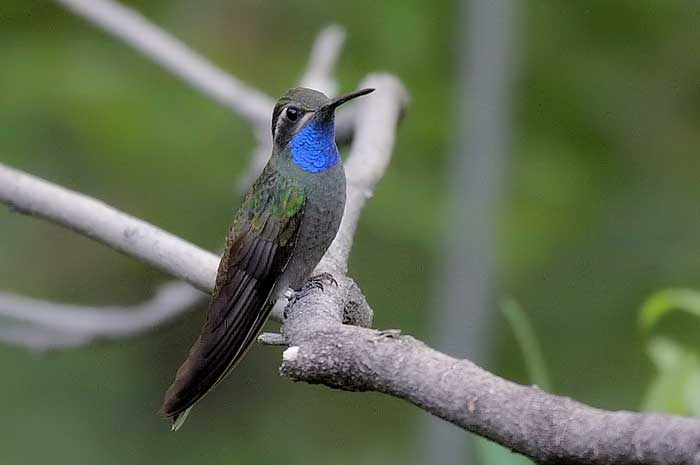
Blue-throated Mountain-gems have a similar, albeit a bit more restricted range than Broad-billed Hummingbirds. Males are characterized by their iridescent bronzy-green upperparts, gray undersides, and iridescent blue throats. They have black tails with white tips and a white stripe behind the eye. Females are similar, but duller and lack the blue throat. Both sexes have a dark bill.
Male Blue-throated Mountain-gems are less colorful than male Broad-billed Hummingbirds. They have grayish undersides and have white stripes near their eyes. Broad-bills lack the white tail tips whereas Blue-throats have a black instead of red bill. Females are a bit more similar, but Blue-throats are duller and have defined white eye stripes.
Frequently Asked Questions
Are female Broad-billed Hummingbirds larger than the males?
On average, male Broad-billed Hummingbirds are slightly larger than females.
Do Broad-billed Hummingbirds have a blue forget?
Broad-billed Hummingbirds have dark, iridescent blue gorgets.
Where do Broad-billed Hummingbirds live?
Broad-billed Hummingbirds generally range throughout Mexico, but they come to breed in the mountainous canyons of the southwestern United States.
Can Broad-billed Hummingbirds survive in a desert?
Broad-billed Hummingbirds can survive in some parts of the desert since they are known to breed in desert canyons.
